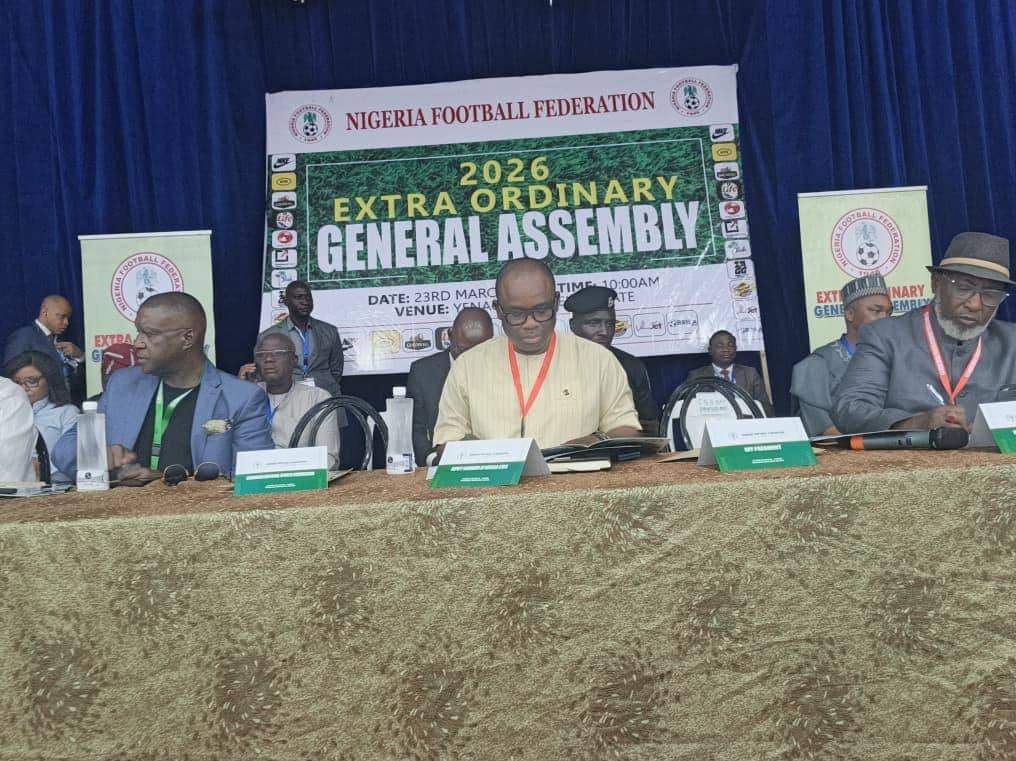
YENAGOA — Nigeria’s football governance structure came under intense review on Monday as the Nigeria Football Federation held its Extraordinary General Assembly in Yenagoa, with the National Sports Commission playing a prominent role in shaping discussions around reforms and institutional alignment.
The high-level congress, staged at the DSP Alamieyeseigha Banquet Hall inside Government House, drew an influential gathering of football stakeholders, administrators, and policymakers from across the country, all united by a common objective — strengthening the administrative framework of the game.
Declaring the assembly open, Bayelsa State Governor, Douye Diri, underscored the importance of synergy between football authorities and national sports institutions, noting that sustainable progress can only be achieved through coordinated leadership and clear policy direction.
A major highlight of the gathering was the growing influence of the NSC in the ongoing reform process, with its leadership advocating structural changes capable of repositioning Nigerian football within global best practices.
The Director General of the NSC, Bukola Olopade, alongside other top officials, was actively engaged in deliberations, reinforcing the Commission’s commitment to governance reforms, transparency, and institutional efficiency.
Also present was the Chairman of the NSC, Shehu Dikko, whose presence further emphasized the Commission’s strategic interest in football development and regulatory oversight.
In his remarks, President of the NFF, Ibrahim Musa Gusau, called for unity among stakeholders, stressing that the success of any reform agenda depends largely on collective responsibility and adherence to established statutes.
Central to discussions at the congress were proposed amendments to key regulatory instruments, including the NFF Statutes, the Electoral Code, and the Standing Orders of the General Assembly. These frameworks, stakeholders agreed, must evolve to reflect contemporary realities and ensure credibility in football administration.
The assembly also reviewed plans for the constitution of critical committees, such as the Electoral Committee and Electoral Appeals Committee, as well as the appointment of an Independent Auditor — all seen as vital to strengthening institutional accountability.
Representatives from FIFA and the Confederation of African Football were in attendance as observers, lending international weight to proceedings and reaffirming global interest in Nigeria’s football governance reforms.
With all 36 State Football Associations, the Federal Capital Territory, and key football bodies — including coaches, referees, and players’ unions — represented, the congress reflected a broad-based commitment to inclusivity in decision-making.
As deliberations continue, there is cautious optimism that the collaboration between the NFF and NSC will usher in a new era of accountability, stability, and growth for Nigerian football, setting the stage for a more competitive and professionally managed domestic game.
NFF, NSC Drive Reform Agenda as Yenagoa Hosts Crucial Football Congress

ByAzuka Chiemeka
Mar 23, 2026