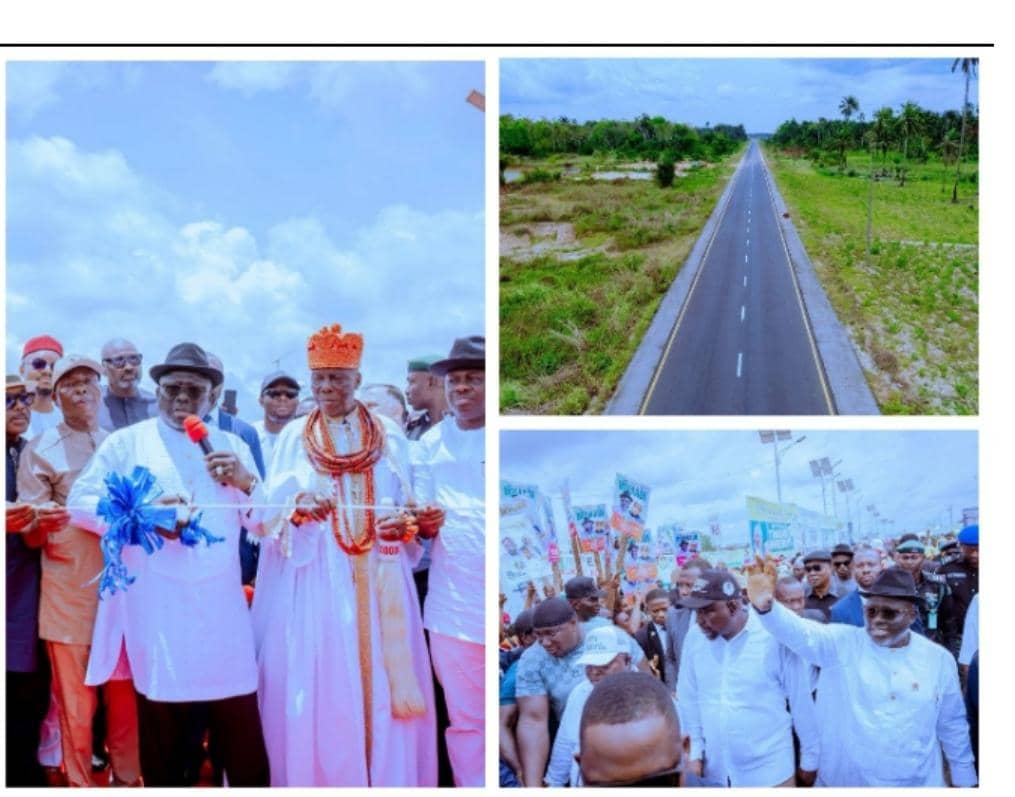
Residents across the riverine axis of Delta State erupted in celebration on Tuesday as Governor Sheriff Oborevwori commissioned the long-awaited 31-kilometre Ohoror–Bomadi Road, a project widely seen as a turning point for communities long cut off by difficult terrain.
Rather than just another infrastructure rollout, the project is being framed by the state government as a strategic intervention aimed at breaking years of isolation in the riverine belt and unlocking new economic possibilities.
Speaking at the inauguration, Oborevwori stressed that the road represents a deliberate shift in governance priorities toward inclusivity and balanced development.
“This is about connecting people to opportunities,” the governor said, noting that riverine communities have historically faced neglect due to their challenging geography.
The newly completed road links key areas including Ughelli North, Ughelli South, Patani, Burutu and Bomadi, forming a critical corridor expected to ease movement, reduce travel time and stimulate commerce across multiple local government areas.
Economic stakeholders believe the road will significantly improve the movement of agricultural produce, open up rural markets and lower transportation costs that have long burdened residents.
The governor highlighted that the project involved complex engineering tailored to swampy terrain, including sand filling, soil stabilization, reinforced concrete works and asphalt surfacing. Sections of the road vary in width from 6.5 to 10.3 metres, with provisions for shoulders in strategic areas.
Oborevwori reiterated that infrastructure remains central to his administration’s MORE Agenda, revealing that projects valued at over ₦400 billion have been approved across sectors such as health, education, power and security.
Beyond roads, he disclosed ongoing efforts to tackle electricity challenges through expansion of transmission lines and installation of transformers, adding that several communities previously in darkness for over a decade have now been reconnected to the national grid.
On security, the governor announced plans to establish police divisions across all 25 local government areas, alongside a Special Protection Base to strengthen safety architecture in the state.
Earlier, Commissioner for Works (Rural Roads) and Public Information, Charles Aniagwu, described the road as a technically demanding project designed for durability, given the difficult environmental conditions.
In his remarks, Bomadi Council Chairman, Dagidi Andaye, said the project marked a historic breakthrough for the area, noting that such large-scale infrastructure had not been witnessed in over 16 years.
Community leaders and stakeholders, including Nicholas Mutu and James Manager, commended the governor’s approach to governance, describing the road as a “relief corridor” that will ease hardship and improve livelihoods.
For many residents, the OhororBomadi Road is more than asphalt and concrete it is a long-awaited bridge to economic inclusion and a symbol of renewed government presence in Delta’s riverine communities.
From Isolation to Opportunity: Oborevwori Opens Lifeline Road to Delta Riverine Communities

ByAzuka Chiemeka
Mar 17, 2026