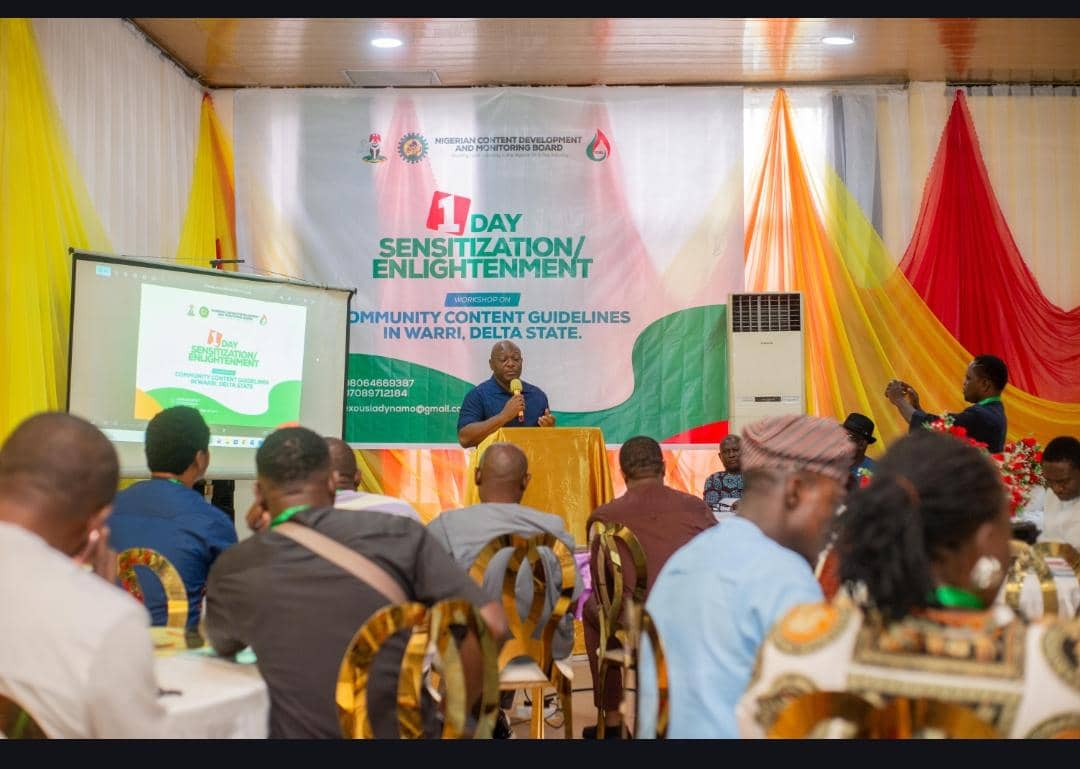
Stakeholders from across Delta State gathered in Effurun on Monday, March 16, 2026, for a one-day sensitisation and enlightenment workshop on community content guidelines aimed at deepening awareness and compliance within host communities.
The well-attended event, held at Wellington Hotel, drew over 150 participants, including community representatives, industry stakeholders, and policy advocates.
In his opening remarks, the Zonal Coordinator for Edo/Delta, Engr. Eyetigha, welcomed participants and underscored the importance of community engagement in driving sustainable development within the oil and gas sector. He noted that effective implementation of community content guidelines would enhance transparency, create opportunities for local participation, and foster stronger relationships between operators and host communities.
Delivering the keynote welcome address, the General Manager, Zonal Coordination, Mr. Ifeanyi Ukoha, highlighted the strategic role of sensitisation programmes in bridging knowledge gaps. He emphasised that stakeholders must be adequately informed about regulatory frameworks guiding community content to ensure inclusiveness and accountability.
The first facilitator, Mr. Kio Mikie, delivered an in-depth presentation on the Nigerian Content Equipment Certificate (NCEC), detailing its relevance in promoting indigenous participation in the sector. He walked participants through the application process, requirements, and compliance procedures, urging companies and community-based enterprises to take advantage of the certification to boost local capacity.
Also speaking at the workshop, Mr. Price Foncha, provided further insights into community content development policies and their practical implications for stakeholders. His presentation focused on aligning community expectations with regulatory standards to ensure seamless project execution.
The General Manager also made additional contributions during the technical sessions, reinforcing the need for collaboration between regulatory bodies, operators, and host communities.
A major highlight of the workshop was the interactive question-and-answer session, where participants engaged facilitators on key issues, ranging from certification processes to community participation in project execution. The session provided clarity on several grey areas and encouraged open dialogue among stakeholders.
Participants commended the organisers for the initiative, describing it as timely and impactful, particularly in equipping communities with the knowledge required to effectively engage with industry players.
The workshop concluded with a renewed call for sustained sensitisation efforts to strengthen community involvement and ensure that the benefits of local content policies are fully realised across Delta State.
Stakeholders Converge in Effurun for Community Content Sensitisation Workshop

ByAzuka Chiemeka
Mar 22, 2026